
Every learner begins their journey with an individual assessment to determine their current literacy skills and personal goals. These goals shape their customized learning plan and guide one-on-one tutoring sessions that can last anywhere from three months to three years. Our goal is to support each learner’s transition toward employment, further education, or greater independence in their daily lives.
The type and length of tutoring, ranging from 3 months to 3 years, is determined by individual goals, current skills, and gaps in skills.
Goal paths represent the overall goal each learner identifies as their main reason for further developing their literacy skills. This directs their training plan development and tutoring sessions while in the program.
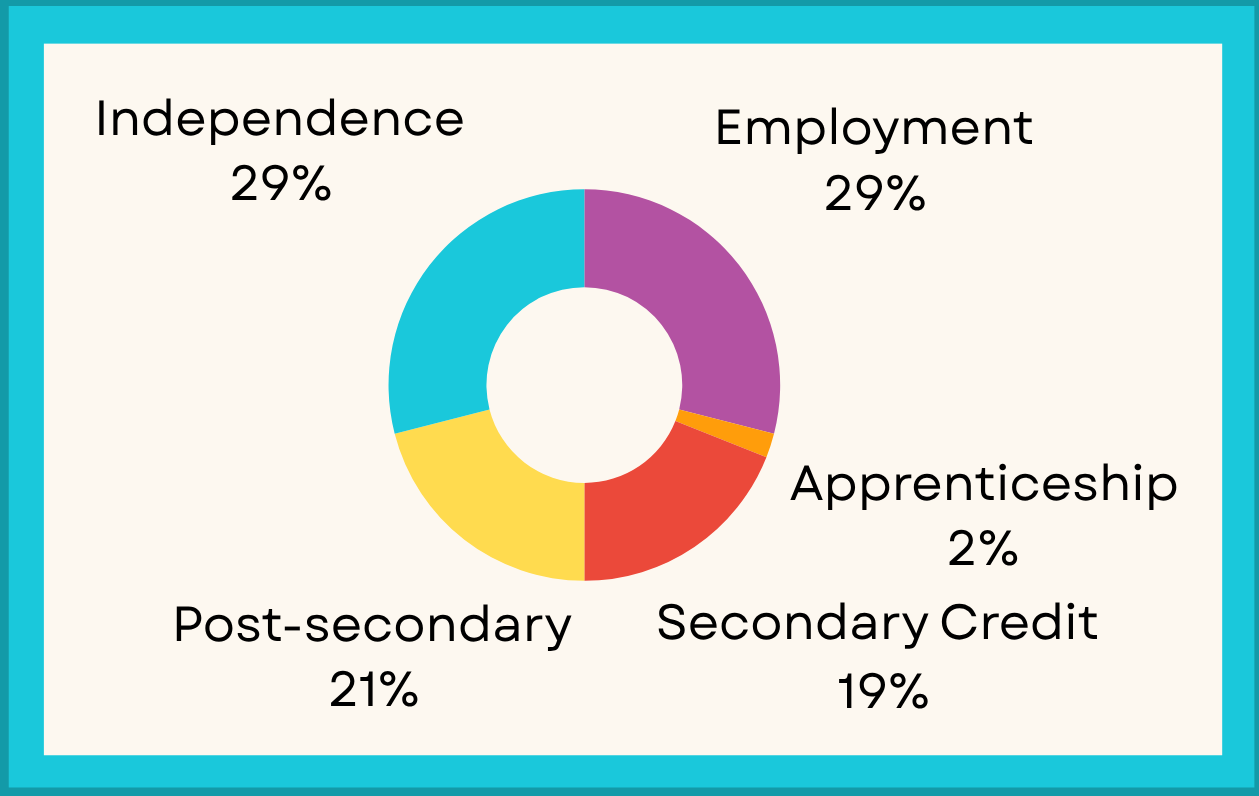
The Graph below indicates Goal Paths identified by new and continuing students ending March 31, 2025.
Our program supports learners through five pathways:
- Independence – develop greater everyday independence (e.g. complete driver’s license tests, count change while shopping, read signs and maps, perform basic computer operations). In 2024, 29% of learners pursued this pathway.
- Employment – prepare for work, maintain employment, or develop skills for better opportunities (e.g. complete job applications, write a resume and cover letters, navigate online job searches, and enhance reading, writing, and computer skills). 29% of learners in 2024 identified Employment as their primary goal—up 11% from the previous year.
- Adult high school – upgrade literacy and math skills to gain entry to adult high school and ultimately receive a high school diploma. Learn to research and write essays. In 2024, 19% of learners chose this path, a decrease of 4% from the previous year.
- Post-secondary – develop writing and math skills to pass college entrance tests, do research, write essays, and learn computer skills including skills required to do online research. 21% of learners in 2024 pursued this path, maintaining strong interest in post-secondary access.
- Apprenticeship – carpenters, welders, electricians and other trades need math, reading and writing skills for on the job, during the educational component of their training and for testing purposes. Each trade has specific terms to describe their work. This pathway was chosen by 3% of learners in 2024.
“Our tutors give back to the East Toronto community by giving the gift of literacy.”
 East York Learning Experience